Reviewed · VIENNA TOURS
Terrible crimes in Vienna, hidden secrets of the inner city
Vienna’s polished center has a darker side: monks locked in a dungeon, a murder case that wrecked an actress’s career, a spy whose secrets shook the monarchy, and medieval punishments that make modern justice seem gentle. This two-hour walk connects those stories to real places, many easy to pass without noticing.
I like two things in particular: the stories give you a fresh way to read familiar streets, and the route links crime to the politics and customs of its time. Guide Ben has researched the material himself, and the walk also includes a complimentary smartphone audio guide.
The main consideration is the subject matter. Some accounts involve torture, murder, and cruelty, so this is better suited to teens and adults than to young children. At $46.13, it is a focused, story-led walk rather than a broad introduction to every side of Vienna.
- Fourteen stops connect grim cases to the old city, from Tegetthoffstraße to St. Stephen’s Cathedral.
- The stories cover centuries of Vienna’s past, including revolution, espionage, medieval justice, and alleged witchcraft.
- The route points out overlooked details, such as a remaining section of the city wall and the site of the old city arsenal.
- Guide Ben has researched the crimes himself, and has also shared stories between the main stops.
- A complimentary smartphone audio guide is included, while the walking tour lasts about two hours.
- Groups are limited to 20 people, which should make it easier to hear the guide in the busy center.
Reading Vienna Through Its Darker Stories
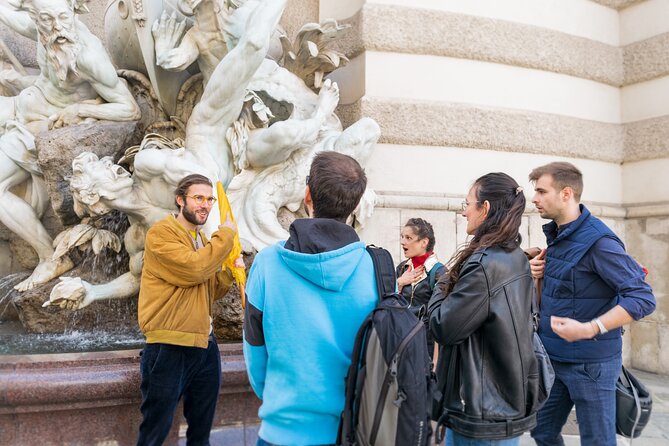
This is not a ghost walk built around jump scares. Its appeal is the way a crime or scandal opens a window onto Vienna’s social rules, political tensions, and changing ideas of justice. A tale of a jealous husband, for example, becomes more than a domestic tragedy when you see how suspicion and public pressure could shape a case.
The route takes you through the inner city, where grand palaces and busy squares can make the past feel tidy and distant. Here, the buildings provide the setting for stories that are anything but tidy. Some sites are striking landmarks; others are simply street corners or former addresses. That contrast is part of the point: the city’s darker history is woven into ordinary streets.
The tour is also a practical way to notice older parts of Vienna you might otherwise walk past. One stop points to a remnant of the city wall, while another connects a square to the arsenal looted during the 1848 revolution. The crimes make the stories memorable, but the route gives you a broader sense of how the city changed.
From Monastery Dungeon to a Murder Case
The walk begins at Helmut-Zilk-Platz, near the Albertina, and moves first to Tegetthoffstraße 2. Here, the story concerns a dungeon at the Capuchin monastery and Father Innocentius, who revealed its existence to Emperor Joseph II. Monks were reportedly confined there for years, sometimes for acts as slight as taking an unauthorized afternoon walk or abusing a monastery official.
The account takes an unexpected turn. Joseph II kept the dungeon closed and sent Innocentius to Lviv, reportedly for his own safety. The priest later became a Protestant, a Freemason, and an adviser to the tsar. This stop sets the tone: the tour is interested not only in what happened, but in the strange turns of the people who tried to expose or control it.
At Trattnerhof, the subject shifts to the Jaroszynski murder case and actress Therese Krones. She was drawn into the scandal despite having little to do with the crime, and her career was ruined by the association. Rumors blamed her supposed extravagance for driving Jaroszynski toward despair and violence, while the account presented here points instead to his gambling addiction and heavy debts. It is a useful reminder that a public scandal can distort a person’s story long after the facts are less sensational.
Other tours people book in Vienna:
- Vienna: Vivaldi’s Four Seasons Concert in Karlskirche
★ 4.7 · 14,951 reviews - Vienna: Spanish Riding School Training
★ 3.9 · 9,281 reviews - Vienna: Skip-the-cashier-desk-line Giant Ferris Wheel Ride
★ 4.5 · 7,859 reviews
A Countess, a Café, and a Carefully Planned Explosion
At Augustinerstraße 12, the group reaches Palais Bathory, associated with Elisabeth Bathory, the figure known as the Blood Countess. The story comes with a major caveat: she has been described either as a serial killer responsible for hundreds of deaths or as the victim of a violent political plot. The familiar claim that she bathed in victims’ blood to preserve her youth belongs to the legend, not a settled account. I appreciate that the ambiguity matters here. This is a tale where separating evidence from lurid reputation is part of the history.
The next story takes you to the Graben and Kohlmarkt, near Demel. In the 1970s, Udo Proksch, an authorized signatory at the confectionery, planned the Lucona affair. A heavily insured freighter was sent toward Asia with an explosive charge hidden aboard. The scheme became a case of mass murder and major insurance fraud, and its investigation dragged on in part because Proksch had connections in many directions.
This stop has a different kind of value from the medieval tales. It shows how a modern crime could expose weak points in powerful networks, and how long it could take to untangle a case with influential people involved. You are standing amid elegant shopping streets, not at some remote crime scene. That contrast makes the story land.
Herrengasse: Murder and Espionage
Herrengasse brings two sharply different episodes. At Palais Ferstel, the former site of a house called Zu den Fünf Morden, the tour recalls one of medieval Vienna’s most notorious mass murders. Five people were killed, including a seven-year-old child. The perpetrator was impaled, a punishment described as exceptionally terrible even by the standards of the period. The execution itself reportedly took a long time because the executioner had little experience with that method.
Opposite Palais Ferstel, the former Hotel Klomser marks the end of Colonel Alfred Redl’s suicide and the exposure of a major espionage scandal. Redl’s spying damaged the army’s reputation and revealed how vulnerable the underfunded Evidenzbureau, the monarchy’s intelligence service, had become. The affair may also have affected the lead-up to the First World War. It is one of the route’s strongest links between a personal crime and the fate of a state.
The shift from a medieval execution to a modern spy scandal is part of the walk’s rhythm. Vienna’s history does not arrive as a neat parade of emperors and architecture. Here, you see how fear, institutional weakness, and personal ambition recur in very different eras.
From the Molker Bastei to Am Hof
At Molker Bastei, the story turns to Anna Gaugisch, murdered and dismembered by her boyfriend Raimund Lewisch in 1861. Some of her remains were found in the Danube and others in a local forge. Lewisch reportedly wanted to get rid of her after she became pregnant. Before the murder, he had drawn attention by dissecting a cat. It is among the tour’s most disturbing stories, and one to keep in mind if you are sensitive to graphic crime accounts.
At Am Hof, the subject is political violence during the 1848 revolution. War Minister Theodor Baillet de Latour was lynched, an unusual episode in Vienna’s history and a prelude to the more violent October Revolution. The same area connects to the civil arsenal, which was looted during the upheaval. The stop helps place the crime within a larger moment of unrest, rather than treating it as an isolated act.
These two stops give the route a useful change of scale. One is a violent crime driven by a private relationship; the other is an act of public violence amid a revolution. Both show how sharply the stakes could rise when personal grievances or political anger turned physical.
Same city, a different kind of day:
- Vienna: Schönbrunn Palace & Gardens Skip-the-Line Tour
★ 4.7 · 7,739 reviews - Vienna: Light of Creation Votive Church Immersive Light Show
★ 4.8 · 6,779 reviews - Vienna Spanish Riding School Guided Tour
★ 4.7 · 6,765 reviews - Vienna: Classical Concert in the World-Famous Musikverein
★ 4.6 · 6,673 reviews
The Hannakenkönig and the Last Wheel in Vienna
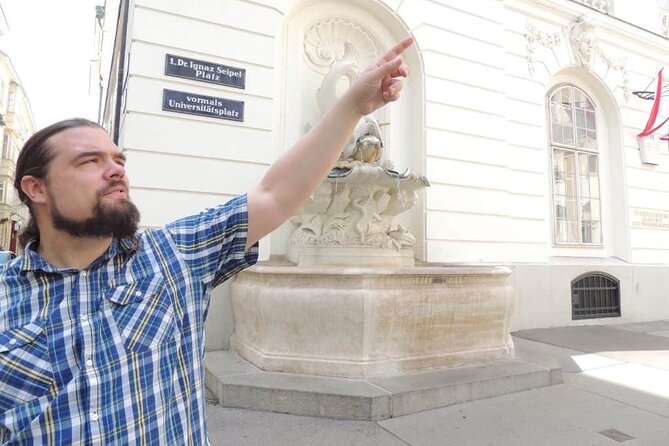
The Hannaken-Brunnen tells the story of the Hannakenkönig, a surgeon said to have caused broken bones so he could profit by treating them. He allegedly set up hazards to make people fall. The fountain depicts two men carrying an injured companion to him. The story is tied to the Hannaken, a minority from Moravia whose members often came to Vienna in search of work.
This stop adds social history to the crime theme. It is not only a tale of a dishonest healer; it points toward the lives of people who moved to the city for work and the popular stories attached to them. The fountain gives you something visible to look at while the guide explains the tale, a welcome change from stops marked only by a former address.
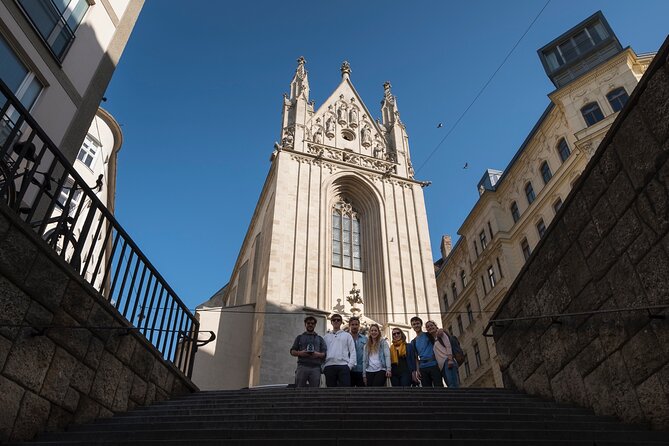
Near Maria am Gestade, the tour discusses the Zahlheim case and the last person wheeled in Vienna. The punishment was a brutal form of execution for murder, and its use is especially striking because it occurred under Joseph II, who generally opposed the death penalty. The facts of this case reportedly led him to make an exception. This is one of the clearest examples of the walk’s larger theme: actual cases could challenge a ruler’s stated principles.
Hoher Markt and the Stories Around St. Stephen’s
At Hoher Markt, the focus is Thekla Riener and her husband, Anton Grünborn. In a jealous frenzy over lovers he imagined, he tortured her with instruments taken from the courthouse, hoping she would name a supposed lover who did not exist. He accidentally killed her, and her parents were driven insane by the events. It is a bleak account, but it also shows how jealousy could become a public legal matter, with official tools turned against an innocent person.
The route then reaches St. Stephen’s Cathedral and the nearby Steffl. One story concerns the supposed standard loaf of bread used to enforce quality in medieval Vienna. The tale has a factual core: bakers who sold bad bread could be put in a cage and dunked repeatedly in the Danube. Similar punishments for public offenders existed in English-speaking countries, too. It is a grim but memorable example of how communities policed daily commerce.
At the former Malefizspitzbubenhaus, once an executioner’s apartment and dungeon, you hear about the Plainacher, the only woman burned as a witch in Vienna. She was accused of bewitching her epileptic granddaughter and summoning demons. Witch trials were not common in Vienna, but the city judge faced public pressure to proceed. This story is another reason to treat the tour as history, not merely macabre entertainment: it asks how fear can push institutions toward cruelty.
A Nun, a Lover, and a Different Kind of Ending
The final stop is Himmelpfortgasse, the former site of the Himmelpfort monastery. In 1319, a nun was walled in because she refused to give up the man she loved, whom her father opposed. The tale has the shape of a Viennese Romeo and Juliet: a mayor and his enemy, children who become close, and a father who chooses a convent for his daughter rather than accept the match.
After the punishments and murders that come before it, this story offers a quieter, still unhappy ending. It also returns the walk to the way private relationships could be controlled by family power and social position. The tour finishes on Rauhensteingasse, still within the inner city, so you can continue exploring nearby on foot.
Is Two Hours and $46.13 Good Value?
At $46.13 per person, this is not the cheapest way to hear a few stories in central Vienna. But you are getting about two hours of guided walking, 14 story stops, a group capped at 20, and a complimentary smartphone audio guide. There are no paid admissions in the route, so the value rests on the guide’s research and storytelling, not access to interiors or exhibits.
That distinction matters. If you want to enter museums or see crime-scene objects, this walk is not that. If you want a guide to connect scattered addresses and landmarks into a coherent narrative, the price is easier to justify. The strongest value is the context: you learn why a site matters and how the story fits Vienna’s political or social past.
The route is described as suitable for most people and is near public transport. The meeting point is Helmut-Zilk-Platz, by Albertina Square, and the end is on Rauhensteingasse. The walk requires good weather and a minimum number of participants; if poor weather or low numbers force cancellation, you are offered another date or a full refund. You can cancel for a full refund up to 24 hours before the start, but changes or cancellations inside that window are not accepted.
Who Should Book This Vienna Crime Walk?
Book it if you enjoy true crime, history, or seeing a familiar city from an unexpected angle. It works especially well for someone who has already seen Vienna’s grand façades and wants stories that get beneath the gilding. A visitor with an interest in the 1848 revolution, the monarchy’s spy service, or old criminal punishments will find plenty to chew on.
I would skip it for young children or anyone who dislikes graphic accounts of murder, torture, and execution. The walk is also a focused theme, not a general city overview, so first-time visitors may want to pair it with a broader introduction to Vienna rather than rely on it alone.
If that darker subject matter suits you, this is a distinctive way to spend two hours in the center. You get a route through overlooked corners, a guide-led narrative shaped by individual cases, and enough historical context to make the city’s handsome streets feel less simple.
FAQ
How long is the tour?
The walking tour lasts about two hours.
What is the price?
The listed price is $46.13 per person.
Where does the tour start?
It starts at Helmut-Zilk-Platz, Albertinaplatz 2-3, in Vienna’s first district.
Where does the tour end?
The tour ends on Rauhensteingasse in the first district.
What language is the tour offered in?
The tour is offered in English.
Is an audio guide included?
Yes. A complimentary smartphone audio guide is included.
How many people can join?
The group is limited to a maximum of 20 people.
Is the tour suitable for children?
The tour information says most people can participate, but the stories include murder, torture, and other gruesome material. It is better suited to teens and adults than to young children.
Can I cancel for a refund?
You can cancel at least 24 hours before the start for a full refund. Cancellations or changes made less than 24 hours before the start are not accepted.
Newest tours in Vienna
- Vienna: ‘Armenia In The Heart Of Austria’ Tour★ 5.0 · 6 reviews
- Vienna: Mozart Private Guided Tour★ 5.0 · 4 reviews
- Vienna: Kunsthistorisches Museum Guided Tour incl. admission★ 4.9 · 32 reviews
- Vienna: Luxury Vintage Fashion Walking Tour★ 3.4 · 8 reviews
- Vienna: Klimt Villa (Gustav Klimt Atelier & Museum) Ticket★ 4.7 · 50 reviews
- Vienna: Johann Strauss – Immersive Audiovisual Experience Ticket★ 4.8 · 60 reviews
- Vienna: Kingdom of Railways Museum Entry Ticket★ 3.6 · 50 reviews
- Vienna: KuK Perfumery Filz – Viennese Perfume Tasting★ 4.3 · 23 reviews
Vienna Tours, compared.
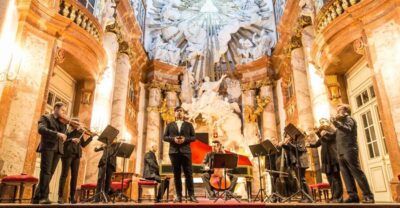
Vivaldi’s Four Seasons Concert in Karlskirche
Read our review →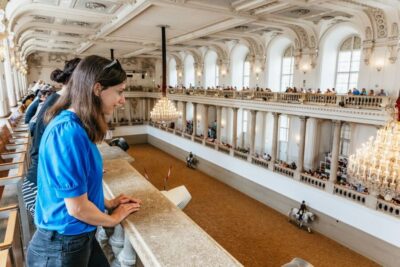
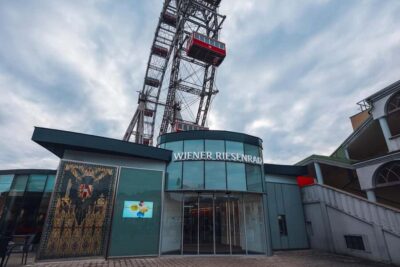
Skip-the-cashier-desk-line Giant Ferris Wheel Ride
Read our review →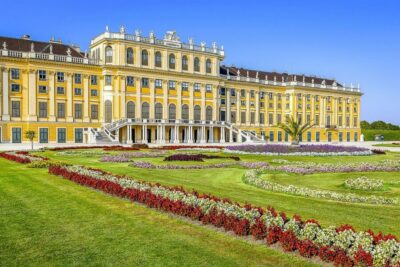
Schönbrunn Palace & Gardens Skip-the-Line Tour
Read our review →
Light of Creation Votive Church Immersive Light Show
Read our review →

Classical Concert in the World-Famous Musikverein
Read our review →