
Reviewed · VIENNA SIGHTSEEING BUS TOURS
Vienna: Bus Tour with Virtual Reality Experience
Vienna’s grand buildings are impressive from the street, but this one-hour ride adds a clever twist: at four stops, you put on VR glasses and meet figures from the city’s past. It is a quick way to connect the landmarks you pass with stories that a window view alone can’t tell.
I like two things in particular: the mix of real streets and virtual scenes gives the ride a clear purpose, and the compact route takes in a generous sweep of central Vienna without requiring a long walk. The air-conditioned minibus is a welcome practical touch, too.
One consideration: this is an overview, not a substitute for time on foot or entry to Vienna’s buildings. You stay outside the sights, and the full tour lasts only about an hour.
What to know before you book
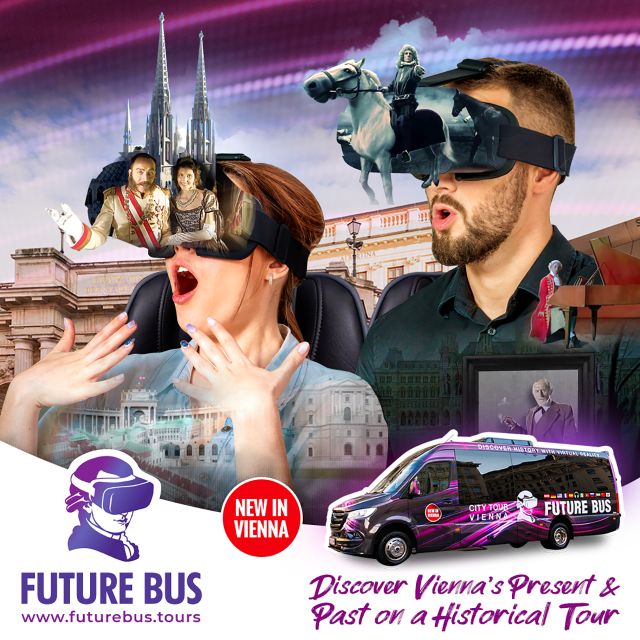
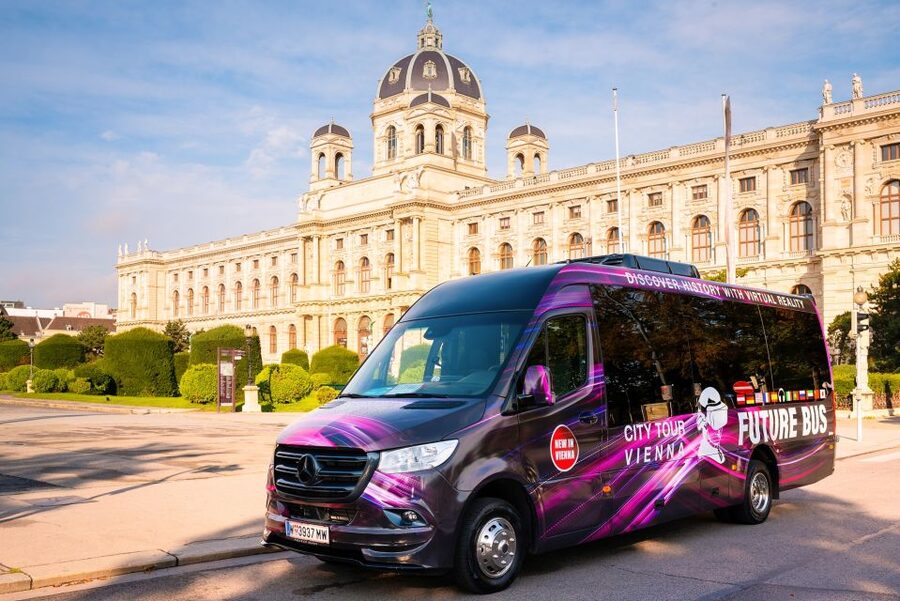
- Four VR stops break up the ride: Put on the glasses at four points along the route, including near Vienna City Hall, at Votive Church and back by the Opera.
- Historical figures appear in virtual scenes: Meet Eugene of Savoy, Archduke Charles and Maria Theresia, among others.
- A wide central route fits into one hour: See the State Opera, Heroes’ Square, the Parliament, MuseumsQuartier, Naschmarkt and more from the minibus.
- The audio guide comes in nine languages: Choose from English, German, Spanish, French, Italian, Japanese, Chinese, Russian or Portuguese, and Arabic is also listed as an option.
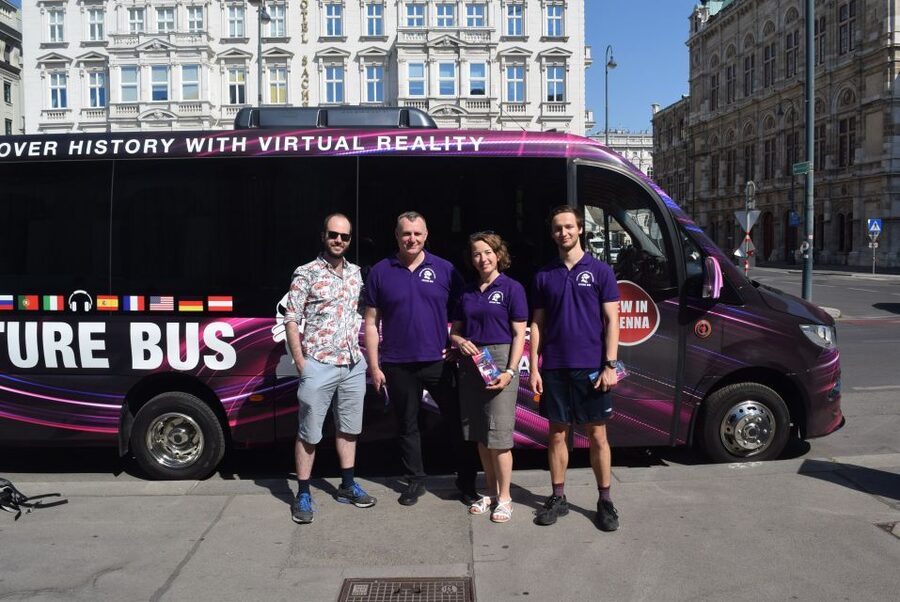
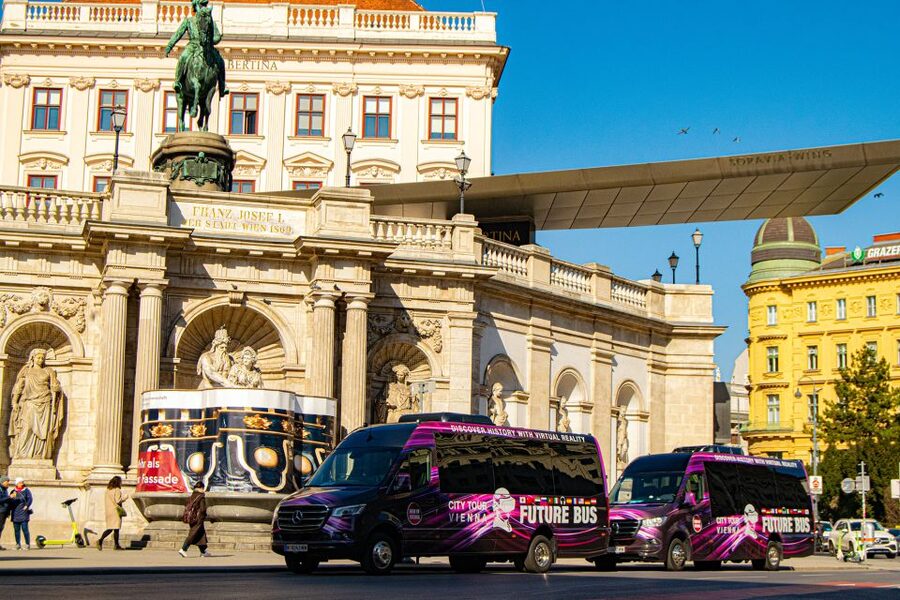
- The ride starts and ends behind the Opera: Look for a purple minibus and a driver in a purple shirt at Albertinaplatz.
- It is a useful first look, not a building tour: The price includes transport, audio commentary and VR glasses, but not entry to buildings, food or drinks.
A fast-moving first look at central Vienna
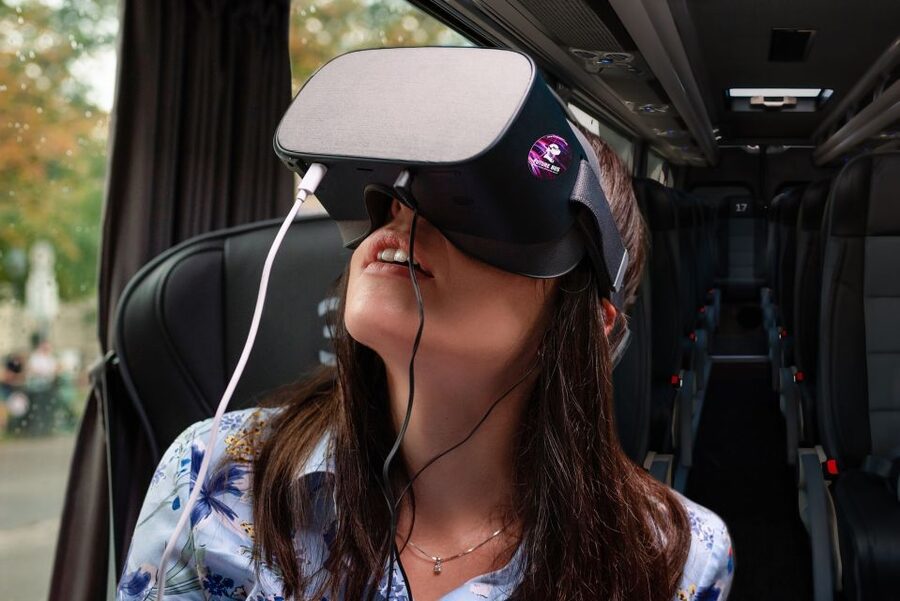
The tour begins at Albertinaplatz, just behind the State Opera. Arrive at least 10 minutes early, show your voucher to the driver or representative, and look for the purple minibus and purple shirt. Once aboard, you receive earphones and a short briefing before the drive begins.
That short introduction matters. The route includes many names and grand façades, and the audio guide gives you a thread to follow as the city passes by. The driver speaks English, German or Russian; the recorded commentary is available in a wider set of languages, including French, Italian, Japanese, Chinese, Portuguese and Arabic. Check the options when booking if language choice is central to your decision.
The minibus is described as comfortable and air-conditioned, with large windows for viewing the sights. You get a sheltered seat rather than the open-air feel of a hop-on, hop-off bus. That suits a short, structured outing, especially if you want to cover ground without walking between each landmark. The trade-off is simple: you cannot linger at a building or get out for a closer look, except during the VR stops.
More sightseeing tours in Vienna:
- Vienna: Hop-On Hop-Off Sightseeing Bus Tour in 19 Languages
★ 4.2 · 4,518 reviews - Vienna: Big Bus Hop-On, Hop-Off Tour by Open-Top Bus
★ 4.4 · 3,529 reviews - Vienna PASS: All incl. Sightseeing Pass for 85+ Attractions
★ 4.3 · 3,067 reviews
From the Opera to Heroes’ Square
The first part of the ride passes some of Vienna’s most recognizable architecture, including the State Opera, the Neuburg, Heroes’ Square and Maria Theresia Square. These monumental spaces make a strong opening, and the audio commentary helps you connect their names and façades to the people and events featured in the virtual scenes.
The first VR stop comes after this opening stretch. Follow the audio guide’s instructions, put on the glasses and encounter figures including Eugene of Savoy, Archduke Charles and Maria Theresia. The main appeal is the shift in perspective: instead of only looking at a building or square from the vehicle, you get a short staged encounter with people tied to Vienna’s past.
The VR element is not the same as entering a historic building. You do not walk through rooms or explore an exhibition, and the virtual segment is a focused experience rather than a long visit. Still, it gives the landmarks a human connection that can be useful if you are new to the city or travelling with children old enough to use the equipment. Children under seven are not considered suitable for this activity.
Parliament, City Hall and the second VR stop
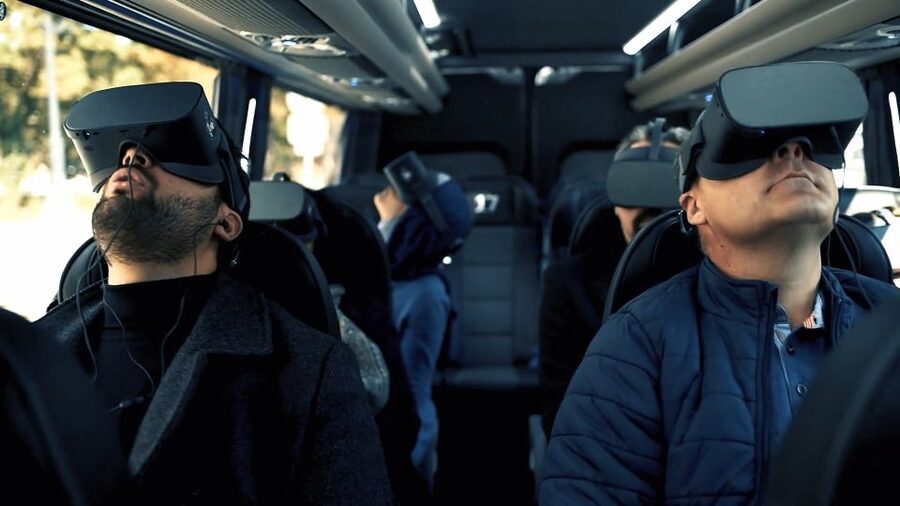
After the first virtual scene, the bus continues past the Volksgarten and the Austrian Parliament, then stops in front of Vienna’s City Hall. The second VR experience takes place near the Burgtheater. Here, the rhythm of the tour is particularly practical: you get a real view of the civic centre, then a chance to pause and focus on a virtual scene without having to navigate the busy streets yourself.
This section works well for anyone trying to get a broad sense of how Vienna’s major institutions sit within the city. You can see the buildings from outside and hear commentary as you go, but you won’t enter them. If a particular façade catches your eye, make a note of it and return later on foot. The minibus is built for a quick survey, not spontaneous sightseeing.
The VR stops also give the hour some welcome variety. Instead of sitting continuously as landmarks roll past, you alternate between looking through the large windows and using the glasses. If you prefer a traditional guided tour with a guide speaking live throughout, this format may feel less personal: the commentary is delivered through an audio guide, while the driver handles the ride and welcomes passengers.
Votive Church and a story tied to Franz Joseph
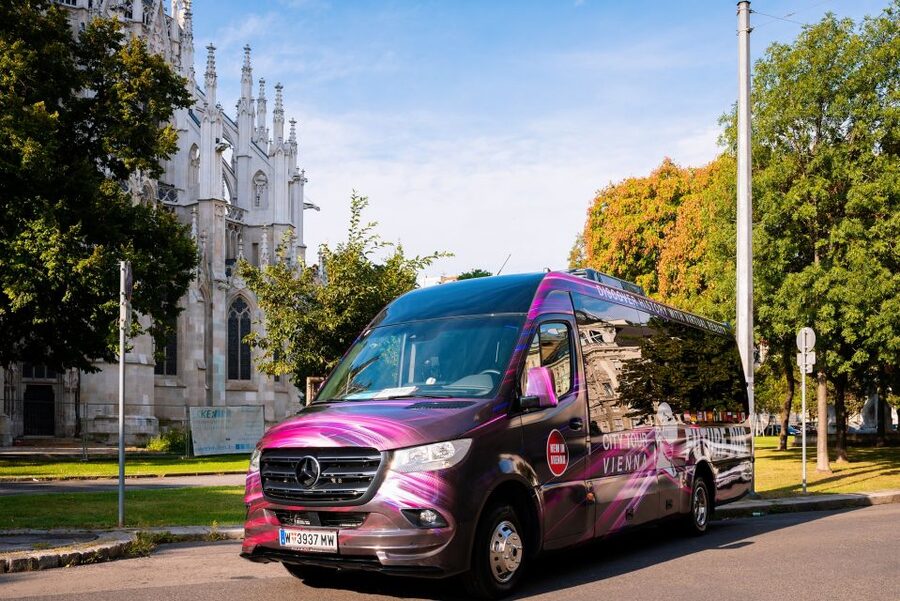
The route continues toward Schottentor and then reaches the Neo-Gothic Votive Church, the site of the third VR stop. The audio guide introduces an assassination attempt involving Emperor Franz Joseph and his brother Maximilian. It is a striking point in the route because the virtual experience gives a specific historical story a place to attach to, rather than leaving it as a name heard in passing.
The stop is one reason this tour can appeal to people who like history but don’t want a full museum visit. You get a brief, visual interpretation at selected landmarks, then move on. That brisk pace is also a limitation: the commentary and virtual scenes can introduce an event, but they cannot give every subject the depth you would find in a longer tour or a book.
If you are sensitive to visual effects or have a visual impairment, note that the activity is not suitable for visually impaired people. It is also listed as unsuitable for people with mobility impairments. The provided details do not explain the exact boarding arrangements, so contact the operator before booking if you need specific access information.
Same city, a different kind of day:
- Vienna: Vivaldi’s Four Seasons Concert in Karlskirche
★ 4.7 · 14,951 reviews - Vienna: Spanish Riding School Training
★ 3.9 · 9,281 reviews - Vienna: Skip-the-cashier-desk-line Giant Ferris Wheel Ride
★ 4.5 · 7,859 reviews - Vienna: Schönbrunn Palace & Gardens Skip-the-Line Tour
★ 4.7 · 7,739 reviews
Museums, markets and the return to the Opera
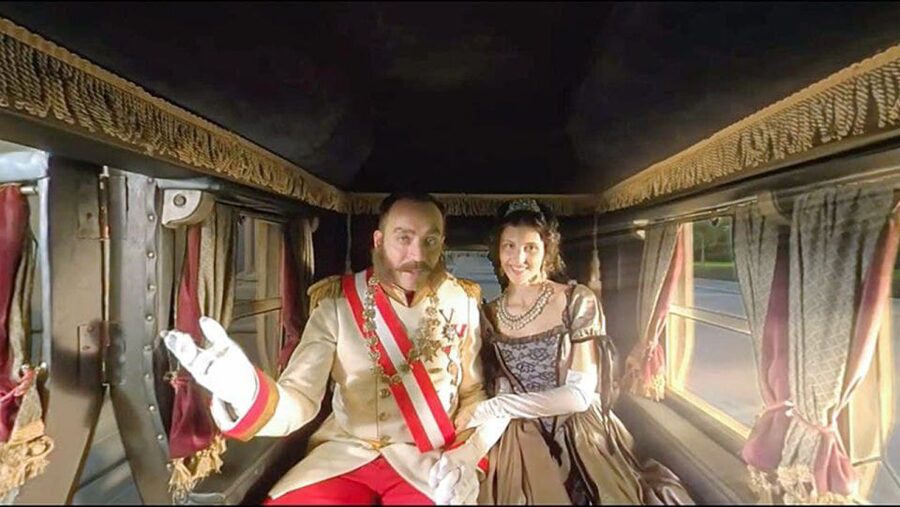
After Votive Church, the bus passes the Volkstheater, MuseumsQuartier, the Secession building, Naschmarkt and Karlskirche, along with other sights on the way back to the Ringstraße. The windows let you take in a lot of the city, but this is the part where the tour feels most like a moving introduction. You’ll see the names and exteriors; you won’t have time to stop at the market, visit a museum or step inside a church.
The last VR stop is back near the starting point behind the Opera. That brings the activity full circle and gives you one more virtual segment before the bus returns to Albertinaplatz. Since the entire ride takes around an hour, it can fit neatly into a day of sightseeing without taking over the schedule. But leave extra time before another booking, as the tour’s stated duration is approximate and the operator asks passengers to arrive early.
One useful way to plan around the route is to treat it as a sampler. After the ride, choose one or two places you saw from the bus and return on foot for a closer look. The tour doesn’t include building entry, so you’ll need separate tickets or plans if you want to go inside.
Does $32 make sense for an hour?

At $32 per person, you are paying for more than a seat on a sightseeing bus: the fare includes the route, audio commentary and high-quality VR glasses at four stops. The value depends on whether you are interested in that combination. If the virtual scenes help you remember what you saw and make historical figures feel less abstract, the extra element gives this short circuit a clear advantage over simply riding around town.
The price is harder to justify if your main goal is to spend time inside Vienna’s landmarks or to explore at your own pace. There is no building admission, food, drink or hotel pickup and drop-off. You pay for a compact, guided overview and its VR feature, not a full day of access.
The tour’s strongest appeal is its time efficiency. You see a broad set of central sights and get four short VR experiences in one hour, without walking between stops. Several particularly positive reactions to the experience centre on the VR making history feel more immediate, the friendly manner of the driver and the comfort of the enclosed bus. Those are meaningful strengths, though the ride is still short and the number of VR stops is fixed.
Who will get the most from this ride?
I’d consider this tour if you have limited time in Vienna, want a low-effort introduction to its main sights, or enjoy technology as part of a cultural visit. It may also suit families with children aged seven or older who want something more interactive than a standard bus circuit. Some families have found it engaging for adults and children alike, but the age restriction is clear: it is not suitable for children under seven.
It is less suited to travellers who want a deep, walking-led explanation, step-free access, or the freedom to stop whenever a landmark catches their eye. The activity is also not suitable for people with mobility impairments or visual impairments. If you prefer open-air sightseeing, a conventional bus may suit you better; if you like combining an overview with brief digital scenes, the Future Bus has a more distinctive format.
Keep the practical rules in mind. Food and drinks are not allowed in the vehicle, and you should bring a passport or ID card. The tour begins and ends at the same meeting point. Free cancellation is available up to 24 hours in advance, and you can reserve now and pay later.
Should you book the Future Bus?
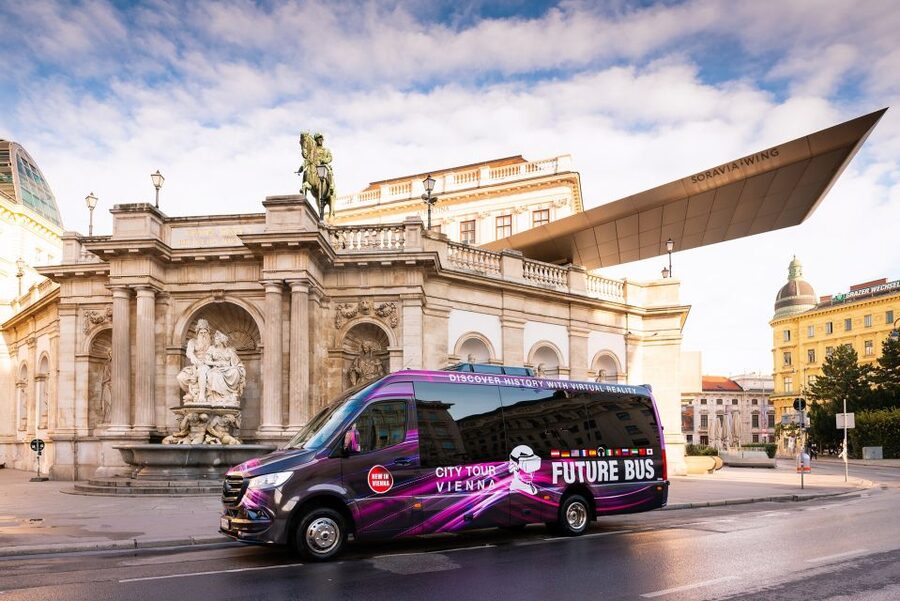
Book it if you want an entertaining, time-saving introduction to central Vienna and are curious about seeing historical figures through VR. The four virtual stops, audio guide and broad city route make the hour feel more purposeful than a simple drive-by tour.
Skip it if you want to go inside the sights, walk at your own pace or spend more than a few minutes on any one subject. For many visitors, the best use of the ride is as a first orientation: take in the landmarks, note what interests you, then return to your favourites on foot.
FAQ
How long does the Vienna bus and VR tour last?
The tour lasts approximately one hour and returns to its starting point behind the State Opera.
Where does the tour start?
It starts at Albertinaplatz, right behind the Opera building. Look for the purple minibus and a driver wearing a purple shirt.
How many virtual reality stops are included?
There are four VR stops during the tour.
Which historical figures can I meet through the VR experience?
The virtual scenes include Eugene of Savoy, Archduke Charles and Maria Theresia.
What languages are available?
The driver speaks English, German or Russian. Audio commentary is listed in English, German, Spanish, French, Italian, Japanese, Chinese, Russian, Portuguese and Arabic.
Are building entrances included?
No. The tour passes Vienna’s sights from the bus, but entry to buildings is not included.
Is the tour suitable for children?
Children under seven are not considered suitable for the activity. The tour information does not specify other age limits.
Can I bring food or drinks on the minibus?
No. Food and drinks are not allowed in the vehicle.
Is the tour suitable for people with mobility or visual impairments?
The activity is listed as unsuitable for people with mobility impairments and for visually impaired people.
Newest tours in Vienna
- Vienna: ‘Armenia In The Heart Of Austria’ Tour★ 5.0 · 6 reviews
- Vienna: Mozart Private Guided Tour★ 5.0 · 4 reviews
- Vienna: Luxury Vintage Fashion Walking Tour★ 3.4 · 8 reviews
- Vienna: Klimt Villa (Gustav Klimt Atelier & Museum) Ticket★ 4.7 · 50 reviews
- Vienna: Kunsthistorisches Museum Guided Tour incl. admission★ 4.9 · 32 reviews
- Vienna: Johann Strauss – Immersive Audiovisual Experience Ticket★ 4.8 · 60 reviews
- Vienna: Kingdom of Railways Museum Entry Ticket★ 3.6 · 50 reviews
- Vienna: KuK Perfumery Filz – Viennese Perfume Tasting★ 4.3 · 23 reviews
Vienna Sightseeing Bus Tours, compared.
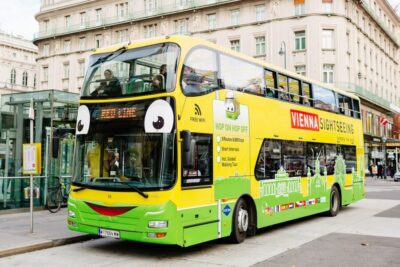
Hop-On Hop-Off Sightseeing Bus Tour in 19 Languages
Read our review →
Vienna PASS: All incl. Sightseeing Pass for 85+ Attractions
Read our review →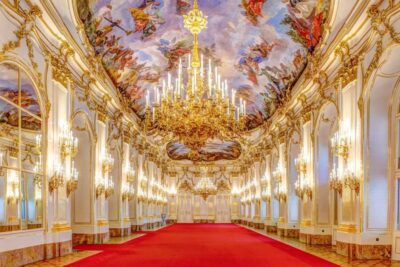
Bus & Schönbrunn Palace Skip-the-Line Guided Tour
Read our review →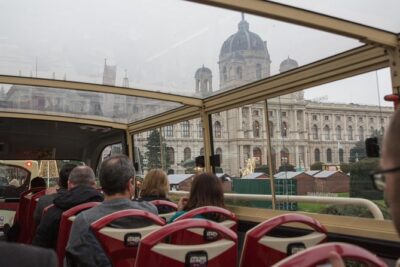
Big Bus Vienna Hop-On Hop-Off Sightseeing Tour
Read our review →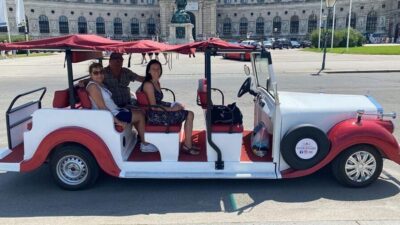
Old Town Sightseeing Tour in a Vintage-Style E-Car
Read our review →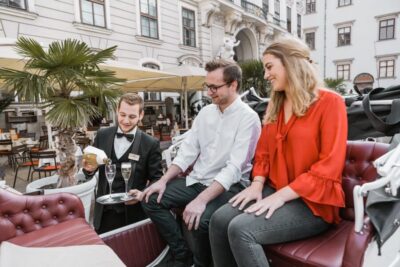

Skip-the-Line Schonbrunn Palace Guided Tour and Vienna Historical City Tour
Read our review →Browse the lists this tour appears in